Mathematical Sequencing in Layered Wagering Across Digital and Venue-Based Formats
Written by Finley Foster · Jun 8, 2026
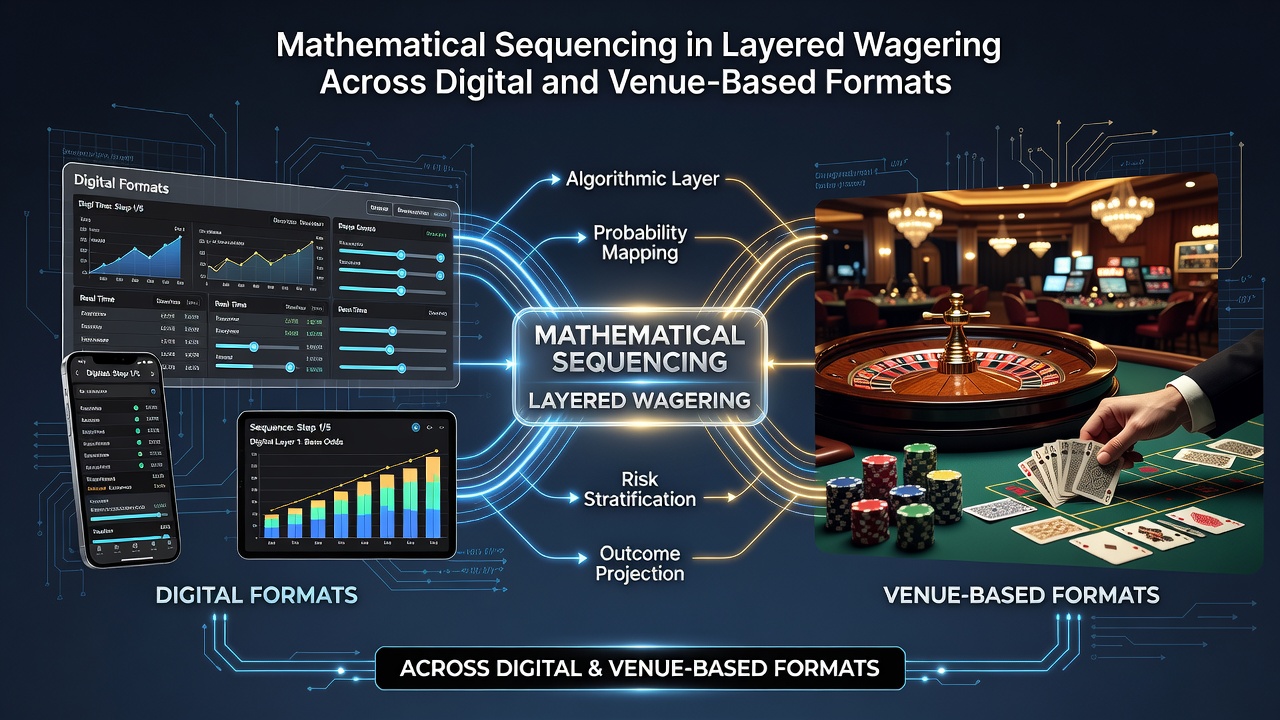
Mathematical Sequencing in Layered Wagering Across Digital and Venue-Based Formats
Layered wagering systems rely on mathematical sequencing to structure bets across multiple stages, where each outcome influences the next wager size or selection criteria, and researchers have examined these patterns in both digital platforms and physical venues since the expansion of online gambling in the early 2000s.
Experts note that sequencing often incorporates principles from probability theory, such as conditional probability chains and recursive algorithms, which allow bettors to adjust stakes based on prior results while maintaining defined risk parameters, and data from regulatory reports indicate steady adoption rates in both formats through 2025.
Core Principles of Sequencing in Wagering
Mathematical sequencing in layered wagering builds on concepts like arithmetic progressions for stake adjustments and geometric sequences for payout multipliers, whereas practitioners apply these models to distribute risk across bet tiers rather than relying on single-event outcomes. Observers note that such structures appear in sports betting accumulators, casino progressions, and poker tournament ladders, where each layer compounds or mitigates exposure according to predefined formulas.
Studies from institutions like the University of Nevada, Reno have documented how Markov chain models help predict transitions between wager layers, and these frameworks reveal consistent patterns when applied to historical performance data across thousands of sessions.
Application in Digital Platforms
Digital environments enable rapid execution of sequenced wagers through algorithmic interfaces that calculate next-layer stakes in real time, and operators integrate these tools into mobile apps and web terminals where users input parameters that trigger automated sequences. Figures from the American Gaming Association show online betting volumes incorporating layered structures grew notably between 2023 and 2025, driven by features that allow seamless movement between bet types.
What's interesting is how digital systems reduce latency in sequence adjustments, enabling users to respond to live data feeds while the underlying mathematics remains identical to manual methods, and software providers have embedded safeguards that cap sequence depth to align with responsible gambling protocols.
Implementation at Physical Venues
Venue-based formats present sequencing through dealer-assisted progressions or self-service terminals, where bettors track sequences manually or via printed guides, and data collected by the Nevada Gaming Control Board indicates layered wagering accounts for a measurable share of table game and sports book activity in land-based properties. Physical constraints such as table minimums and chip denominations influence how sequences unfold, creating variations from purely digital executions.

Researchers have observed that venue staff training programs now include modules on recognizing common sequence patterns, which helps maintain game integrity while supporting player engagement, and case studies from major casino operators demonstrate integration of sequencing into loyalty programs that reward consistent layered play.
Comparative Analysis of Formats
Digital and venue-based formats diverge in execution speed and data accessibility yet converge on the same mathematical foundations, and analysts at the Canadian Centre on Substance Use and Addiction have compared participation metrics showing similar risk distribution profiles when sequences span equivalent numbers of layers. Venue settings introduce social and environmental variables that can alter decision timing, whereas digital platforms supply instant feedback loops that reinforce sequence adherence.
Reports scheduled for release in June 2026 from international gaming research bodies are expected to provide updated cross-format statistics, building on earlier findings that layered wagering maintains stable house edges regardless of delivery channel when properly sequenced.
Regulatory and Industry Context
Regulatory frameworks in multiple jurisdictions require transparency around sequencing tools, and industry organizations such as the European Gaming and Betting Association have issued guidelines emphasizing clear disclosure of how algorithms calculate layer transitions. These measures aim to ensure players understand the probabilistic outcomes embedded in each sequence stage.
Academic papers published in journals focused on gambling studies continue to explore optimizations for sequencing under varying house rules, and evidence suggests that cross-format consistency in mathematical modeling supports more accurate player education initiatives.
Conclusion
Mathematical sequencing provides a structured approach to layered wagering that spans both digital and venue-based environments, with core principles remaining constant while delivery mechanisms adapt to each format's characteristics. Ongoing data collection from diverse regulatory and research sources will continue to inform how these systems evolve through 2026 and beyond, offering clearer pictures of their application across global markets.